

TL;DR
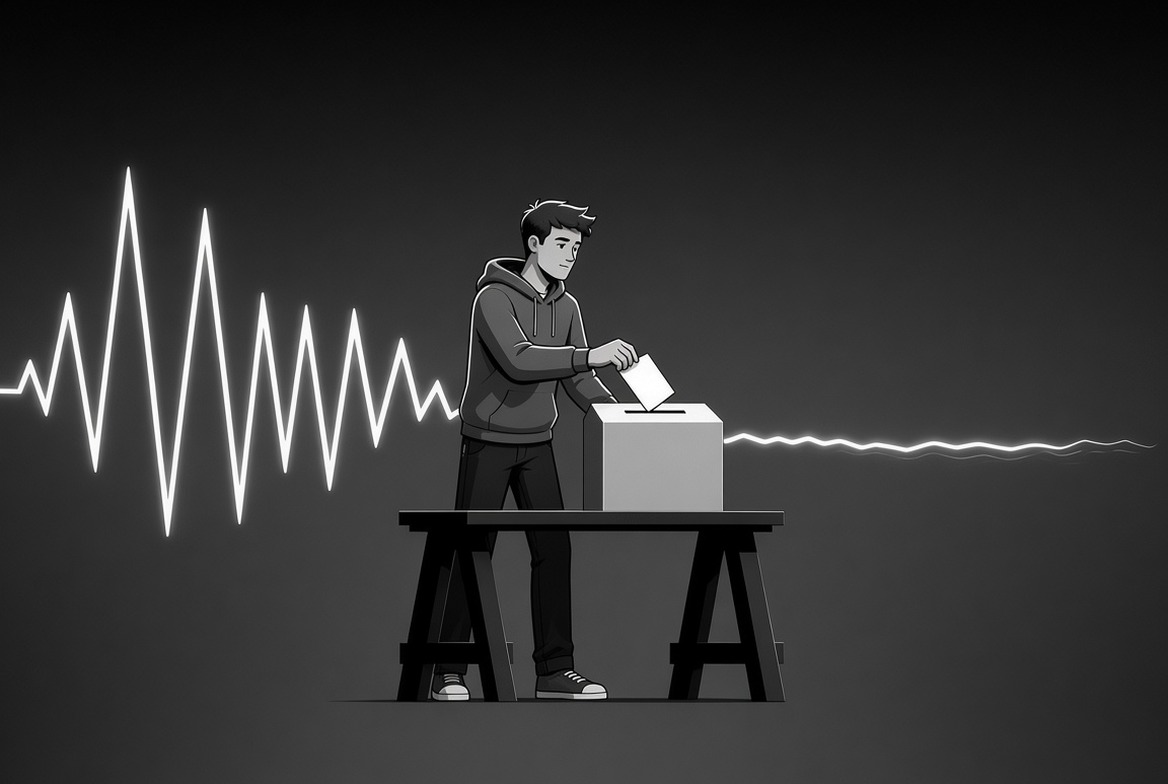
- Elections move markets through uncertainty, not through who wins. Like a jobs report, a Fed decision, or earnings, an election is a scheduled binary event, and prices get less stable going into it.
- Volatility around an election has three stages. It expands before the event, peaks around the event, and usually contracts once the result is known.
- A process-driven investor positions for each stage. Before the vote, avoid positions that rising volatility would hurt. After it, look at positions that benefit when volatility settles.
- You don't have to time it by gut. Miiflo's model adapt to the volatility environment, so the "drips" you see change with the cycle.
Election season feels like a coin flip with your savings on it
The headlines get louder. Every cable segment tells you the outcome will make or break the market. Your feed fills with people who are certain they know which way stocks will go after the vote.
So you do what most people do. You freeze, or you guess. You sell because it feels risky, or you load up because someone sounded confident. Either way, it feels like the result is something that happens to you.
Here's the more useful truth. You don't need to know who wins. The thing that actually moves prices around an election is something you can see coming months ahead: uncertainty.
The outcome matters less than the uncertainty
Start with the party question, because it's the one everyone argues about. Over the long run, it's mostly noise. Capital Group's research found that elections have made "essentially no difference when it comes to long-term investment returns," and stocks have trended higher under both parties. Going back to 1933, markets have averaged double-digit returns whether one party controlled Washington or power was split.
What does show up, election after election, is a pattern in volatility.
Elections are binary events
An election is a scheduled event with a yes-or-no kind of result, like a nonfarm payrolls report, an FOMC rate decision, or a company's earnings. Before it lands, nobody knows the answer. After it lands, everybody does.
That gap between "unknown" and "known" is where the market's behavior comes from.
Price discovery: why volatility expands, then contracts
When uncertainty rises, markets do price discovery. Buyers and sellers push prices around, testing what the asset is worth under each possible outcome. More uncertainty means more testing, and more testing means bigger swings. Volatility expands.
Then the event passes. More is known. The testing stops, and prices settle back toward equilibrium. Volatility contracts.
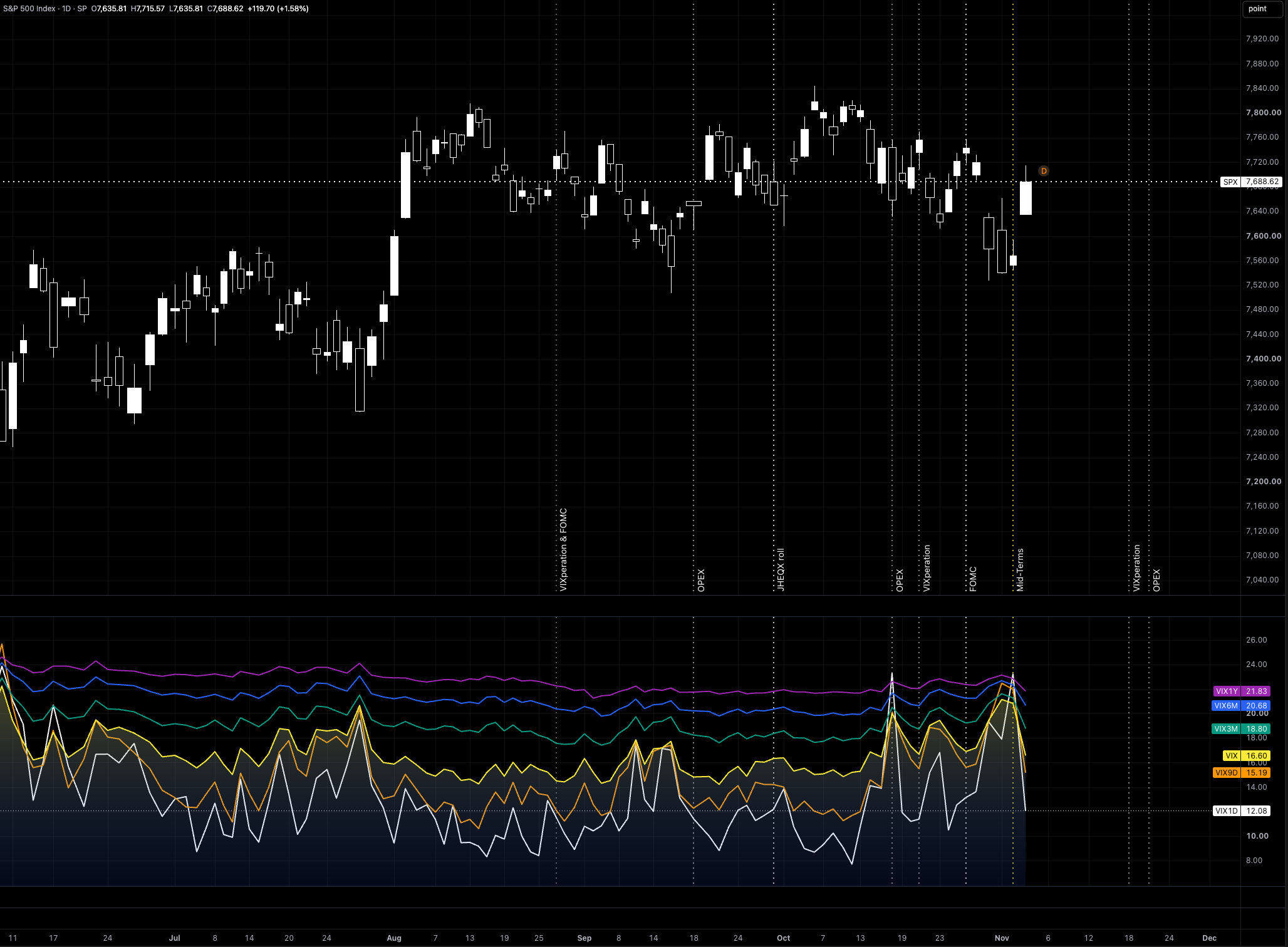
You can see this in the VIX, the market's volatility index, built from S&P 500 option prices. The St. Louis Fed found that in seven of the last 10 presidential elections, the VIX fell from election day to the next day. The exceptions had their own reasons, like the contested 2000 result and the 2008 financial crisis. SIFMA looked at a slightly longer window and found that five days after election day, the VIX had settled back down in six of seven election periods they analyzed, excluding 2000.
That's not a guarantee. It's a tendency, and it's one worth building a process around.
The flows behind the swings
This isn't just mood. It's money that has to move, the same kind of flows that drive the market every day:
- Hedging demand rises into the event. Funds buy protection ahead of the vote, which bids up option prices and pushes the VIX higher.
- Options dealers adjust. Dealers take the other side of that hedging and buy or sell stock to stay neutral. Their hedging can make swings bigger while uncertainty is high.
- Cash waits on the sidelines. Some investors simply wait until the result is in.
- Then it unwinds. Once the outcome is known, hedges come off, dealers rebalance, and sidelined money comes back. That's the relief move people talk about after an election.
How it shows up across the cycle
Think of it in three stages:
- Before the event: expansion. Uncertainty builds, protection gets expensive, and prices get jumpy. Policy guesses shift money between sectors too, as investors try to position for which industries might benefit. Most of that is speculation.
- The event itself. The binary moment. The result lands, and the market reprices to it, sometimes sharply, for a day or two.
- After the event: contraction. More is known. Hedges come off, sidelined cash returns, and volatility tends to settle.
Here's the line to remember: what comes after volatility expansion? Volatility contraction.
The plan: position for the whole cycle, not the outcome
A process-driven investor doesn't try to call the winner. They know the event is on the calendar, and they hold positions that anticipate each stage.
- Know the event is coming. Elections, jobs reports, Fed decisions, and earnings are all scheduled. Mark them, and expect volatility to expand into them.
- Before the event, stay out of what expansion would hurt. Positions that need price to sit still and volatility to fall are the wrong tool while uncertainty is still building.
- After the event, look at what contraction rewards. Once volatility has expanded and the result is known, positions that benefit from prices settling into a range become more attractive.
- Know your max loss before you start. Whatever the stage, use defined risk so a surprise result can't take more than you planned to put on the line.
What this looked like inside Miiflo
Here's the "after" half of that cycle in action, using the sell iron condor.
Going into the election, Miiflo's Bflow model surfaced very few sell iron condors. Volatility was still expanding, and those positions would have been hurt by it. After the event, more of them started to show up, because volatility had expanded enough to make those positions attractive as it contracted.
Nobody had to predict the winner. The model adapted to the volatility environment, so we weren't in positions that rising volatility would hurt, and it found opportunities once the uncertainty cleared. Probabilities, not predictions.
That's the job Miiflo does every day. We scan 8,000+ stocks and ETFs using end-of-day market data and surface ideas that fit the current environment. Every Drip shows its max loss up front.
What it costs to ignore the cycle
If you treat an election as a bet on the winner, you're playing a game the long-term data says barely matters. Meanwhile, you're exposed to the part that does matter. You might sell into the peak of fear right before volatility contracts, or take on positions that get hurt as uncertainty builds. You end up paying for the swings without a plan for them.
From bracing for the news to planning for it
Here's the shift. Election season stops being something that happens to you. It becomes a known event on the calendar, with a rhythm you can see: expansion, event, contraction.
You stop trying to guess the headline. You focus on the only thing you can actually control, which is your risk, and you position for the stage the market is in.
Practice the cycle, with nothing on the line
Start in paper mode: real market data, zero real money. Watch how the ideas Miiflo surfaces change as volatility builds into the next scheduled event and settles after it. Then use defined risk to decide how much to put behind each idea.
Investing & trading involves a substantial risk of loss and is not suitable for all investors. Past performance is not necessarily indicative of future results.